Written by TCEC President & CEO Scott Spence
In April's board meeting, directors approved a structured process for handling large load inquiries from hyperscale operators and other large industrial users. This framework protects TCEC members from shouldering financial risks that should be borne by private developers. Let me explain why this process matters and how it aligns with the disciplined financial management this leadership team has implemented since 2024.
Why This Framework Was Necessary
The electric utility industry is experiencing an unprecedented wave of large load inquiries. Currently, there are over 230 gigawatts of requested large load projects across ERCOT. That's two-and-a-half to three times the size of the grid's current peak demand of 85 gigawatts on the hottest day. While many of these proposed projects are highly speculative and may never be built, the sheer volume has fundamentally changed how utilities must handle them.
For context, a single large load campus could demand hundreds of megawatts. TCEC's current peak load is around 1,000 megawatts, so adding even one of these facilities would represent a massive increase. More importantly, serving these loads would require tens to hundreds of millions of dollars in infrastructure investments including transmission lines, distribution upgrades, substations, and specialized equipment. Some components, like substation transformers, can take two years or more to arrive once ordered.
Here's the risk: if TCEC were to cover these costs and the developer backed out, went out of business, or changed locations, the Cooperative and its members would be stuck paying for what the industry calls "stranded assets." That's exactly the kind of financial exposure this leadership team will not allow.
Many developers are "shopping" across multiple utilities, and some lack legitimate backing, site control, or confirmed tenants. Without proper guardrails, cooperatives could spend millions on studies and infrastructure for projects that never materialize.
This risk is not theoretical. In the September 2024 issue of Current Conversations, I detailed how aggressive subsidization of new member construction costs materially contributed to the debt challenges this leadership team inherited. For six years prior to 2024, TCEC paid more than $10,000 in construction costs per new member to connect services. With over 4,000 new meters installed annually, this practice cost the cooperative $40 million per year and increased debt by $240 million over the life of the program. These subsidies were neither reported nor budgeted and were inconsistent with industry best practices.
That $240 million represents roughly one-third of the debt mountain we have been working to reduce. The new leadership team quickly uncovered these hidden costs and stopped the subsidizations in 2024. We will not repeat that mistake with large loads.
Legislative Context and Cooperative Policy
In 2025, the Texas legislature passed Senate Bill 6, which mandates that large loads, typically above 75 megawatts, participate in formal engineering studies and pay for their own grid impacts. This legislation reflects a broader recognition across the utility industry that existing members should not subsidize private commercial development.
TCEC is applying this same logic to all large loads from 2 megawatts and up. The principle is simple: developers pay their own way, and members are protected from financial risk.
 The Four-Step Intake Model
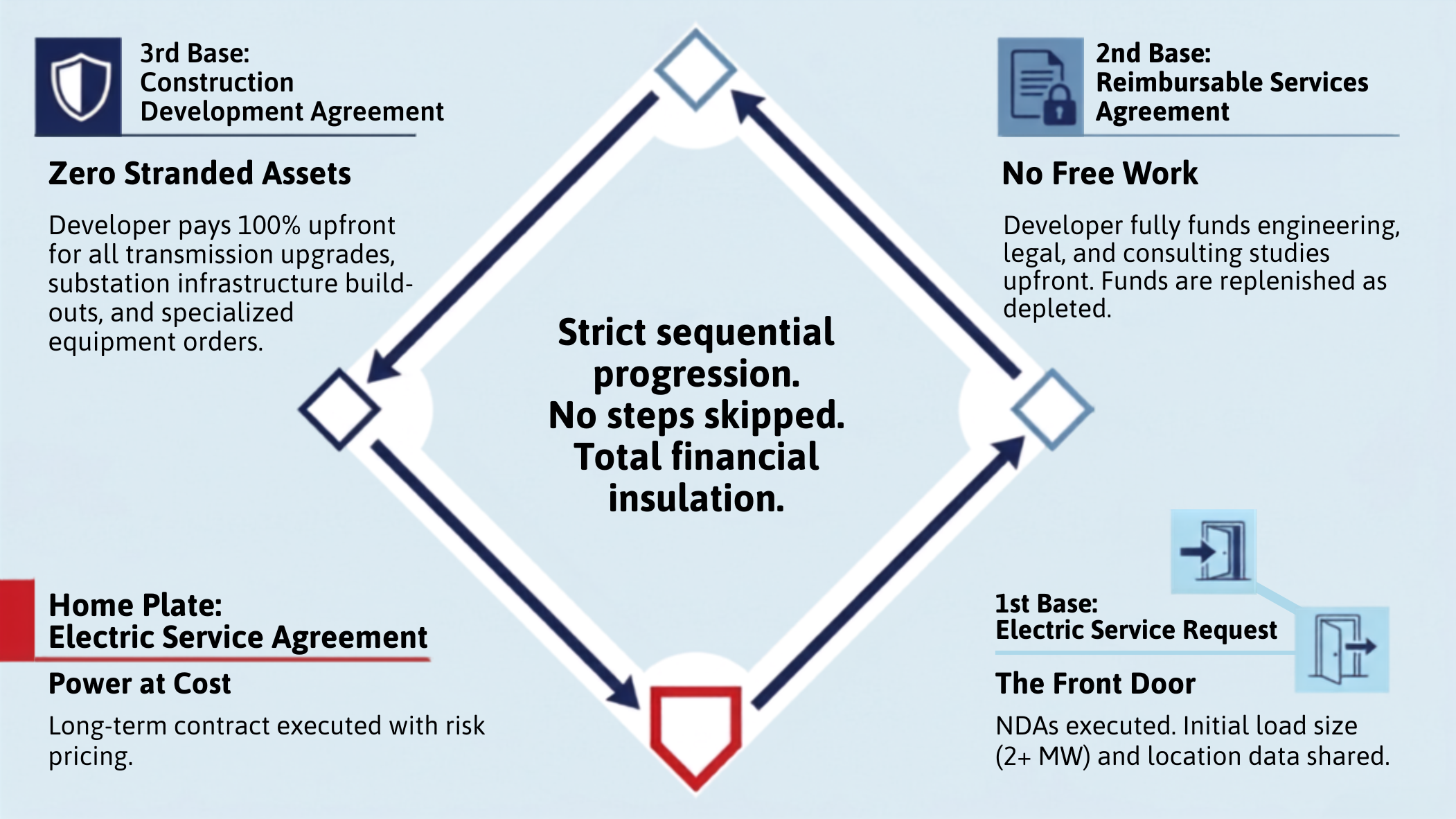
To protect members while welcoming legitimate developers, TCEC has developed a four-step framework for large load prospects. Think of it like bases in baseball. Each step must be completed before moving to the next:
Step 1: Electric Service Request (First Base) This is the "front door" where both parties share initial information such as the load's size, desired location, and requirements. This step includes Non-Disclosure Agreements to protect sensitive infrastructure data.
Step 2: Reimbursable Services Agreement (Second Base) This step is based on the principle of 'no free work.' Before TCEC performs necessary engineering, legal, or consulting studies, the developer must fund this work upfront and replenish the funds as they are depleted. Members will not pay for studies that benefit private businesses.
Step 3: Construction Development Agreement (Third Base) Once cost estimates are approved, the developer must pay upfront for all construction costs, equipment orders, and infrastructure buildouts. This shields members from massive upfront cash flow risk and eliminates the possibility of stranded assets.
Step 4: Electric Service Agreement (Home Plate) A long-term contract designed to protect the cooperative from ongoing risks, such as increased transmission expenses and energy procurement costs. Developers pay for everything. Members pay nothing and carry no risk.
TCEC's Position
Let me be clear about several things. First, TCEC has no preference about whether large loads are located in our service area. We are accommodating legitimate developers who are willing to follow this process, but we are financially indifferent to the outcome.
Second, decisions about zoning and land use are matters managed by local and state government, not TCEC. Those are planning and policy questions that communities and elected officials must decide based on their values and priorities. If local or state governments approve these projects, TCEC has an obligation to serve.
Third, this framework aligns with Texas SB 6 principles, and the broader utility industry position that large-load risks and infrastructure costs should not be shifted onto existing members. This is about financial discipline and protecting the equity our members have built in their Cooperative.
Current Status
Currently, TCEC has received several preliminary inquiries, but only a couple have progressed past the first phase. The board's unanimous vote to approve the four documents associated with this intake model ensures that any future large load request will be handled with the same disciplined approach we have applied to all aspects of TCEC's finances since 2024. You can review the approved large load process documents at tcectexas.com/large-load-requests.
Why Disciplined Management Matters
This leadership team has consistently demonstrated that we will not repeat the practices that created the debt mountain we inherited. Whether it's ending construction subsidies, locking in fixed wholesale power rates to avoid market volatility, or requiring developers to pay their own infrastructure costs, every decision is guided by one principle: protecting members from financial risk while providing safe and reliable power at the lowest possible cost.
The large load intake model is another example of that commitment. It ensures that if these projects come to TCEC's service territory, members will be protected, and the Cooperative's improved financial position will be preserved.
Scott Spence, President & CEO